
Alpha
Ethos: Rebuilding Web3 Trust with On-Chain Reputation
Ethos is building trust in Web3 with on-chain reputation scores shaped by real users — not hype or paid influence. It's a crypto-native system where your actions speak louder than marketing.
Quick Overview
- Decentralized platform for on-chain trust and user credibility
- Reviews, vouches, and slashes shape public reputation scores
- Invite-only system with shared responsibility incentives
- Contributor XP rewards active, honest participation
- No token yet, but top users already earn high-value NFTs
- Case study: Eclipse & Alucard show how community enforces accountability
- Ethos aims to fix crypto’s scam problem with transparency and social proof
Ethos — A Reputation System for Web3
Ethos is a platform that helps build trust in Web3 using a decentralized system. It lets anyone leave a review that gets saved directly on the blockchain. With tools called vouch and slash, it creates a credibility score that shows how trustworthy someone is. In a time when online scams are getting more advanced, Ethos makes it easier to tell who you can trust and who you might want to avoid.
How Ethos Got Started
Ethos was started in late 2023 by two entrepreneurs who used to work in Web2. The co-founders — Trevor Thompson (CEO, also known as Serpin Taxt / 0x5f Capital) and Ben Walter (CTO, also known as smirks) — were inspired by trending crypto projects like Friend.tech. Before Ethos, they made and sold software tools used by millions.

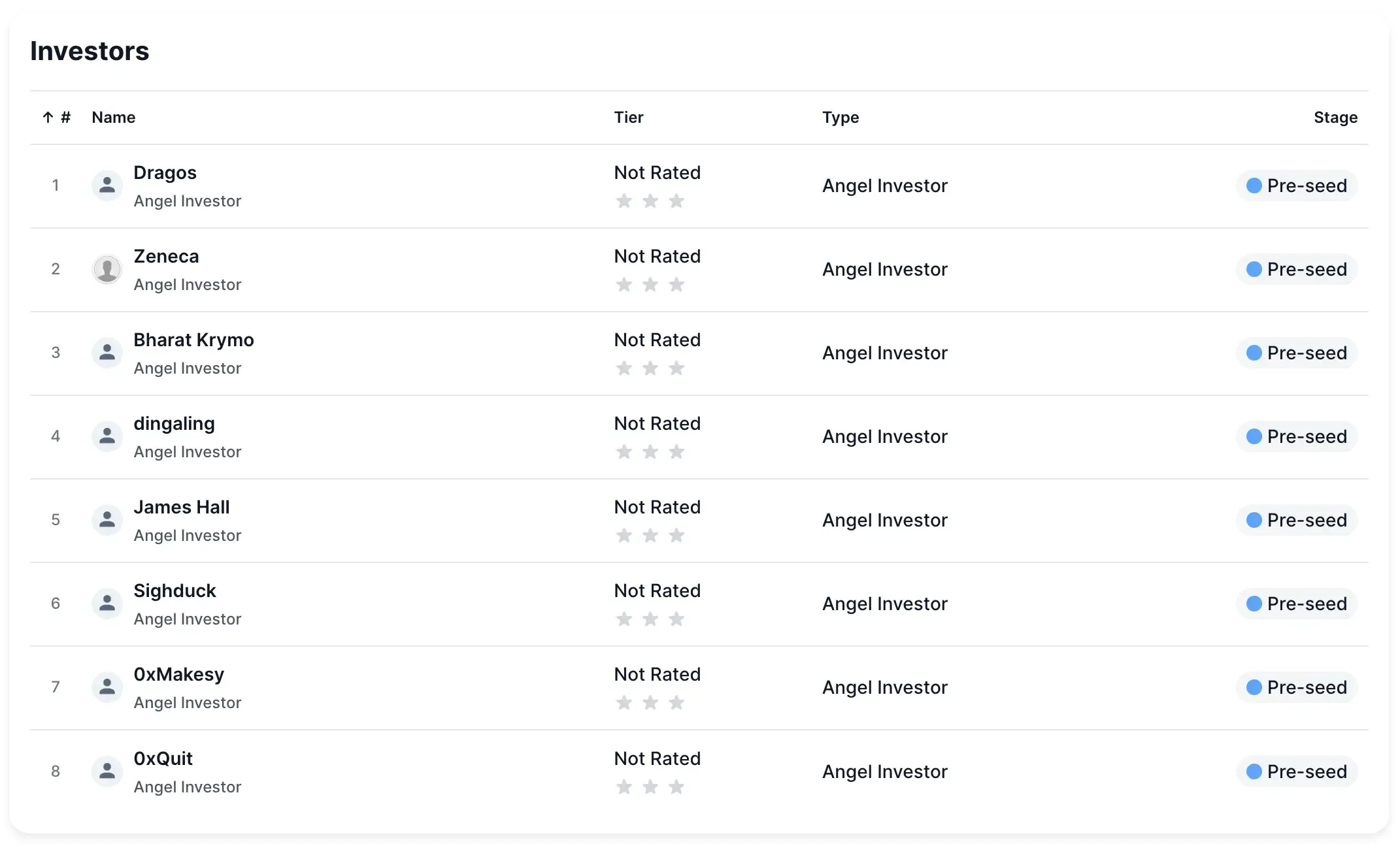
Ethos was their first big move into Web3. They officially quit their jobs in January 2024 and raised $1.75 million by May, mostly from online communities and without any big-name investor. This shows how deeply the project is tied to the crypto community — many people believed in the idea and backed it with their money.
One of Ethos’s key beliefs is "anonymity as a core crypto value," but to gain trust, the founders chose to show their real identities on Twitter. That’s pretty rare these days, when many project leaders hide behind profile pictures in Discord.
Ethos Mission and Goals
Ethos’s main goal is to create a reputation system for Web3 that tackles the problems of total anonymity and rising fraud. The platform helps build a public record of user behavior — showing both good and bad actions — based on reviews from others. These records are stored on-chain and can’t be changed. This way, anyone can check if a person is known to be trustworthy or not.
The Ethos blog talks about this problem as "Web3 onchain fraud" and says it can be fixed by adding review systems. Basically, the idea is to let the Web3 space manage itself: if someone acts shady, they’ll get a negative review, and if someone helps the community, they’ll get a better score. The blog explains that once Ethos becomes popular, people in Web3 will act more responsibly, which will make the space safer overall. The team hopes this will encourage new users to join. If the crypto world becomes more trustworthy, it won’t seem like a risky or scam-filled place to newcomers.
How Reputation Works in Ethos
Ethos uses several key features to shape reputation:
Review System
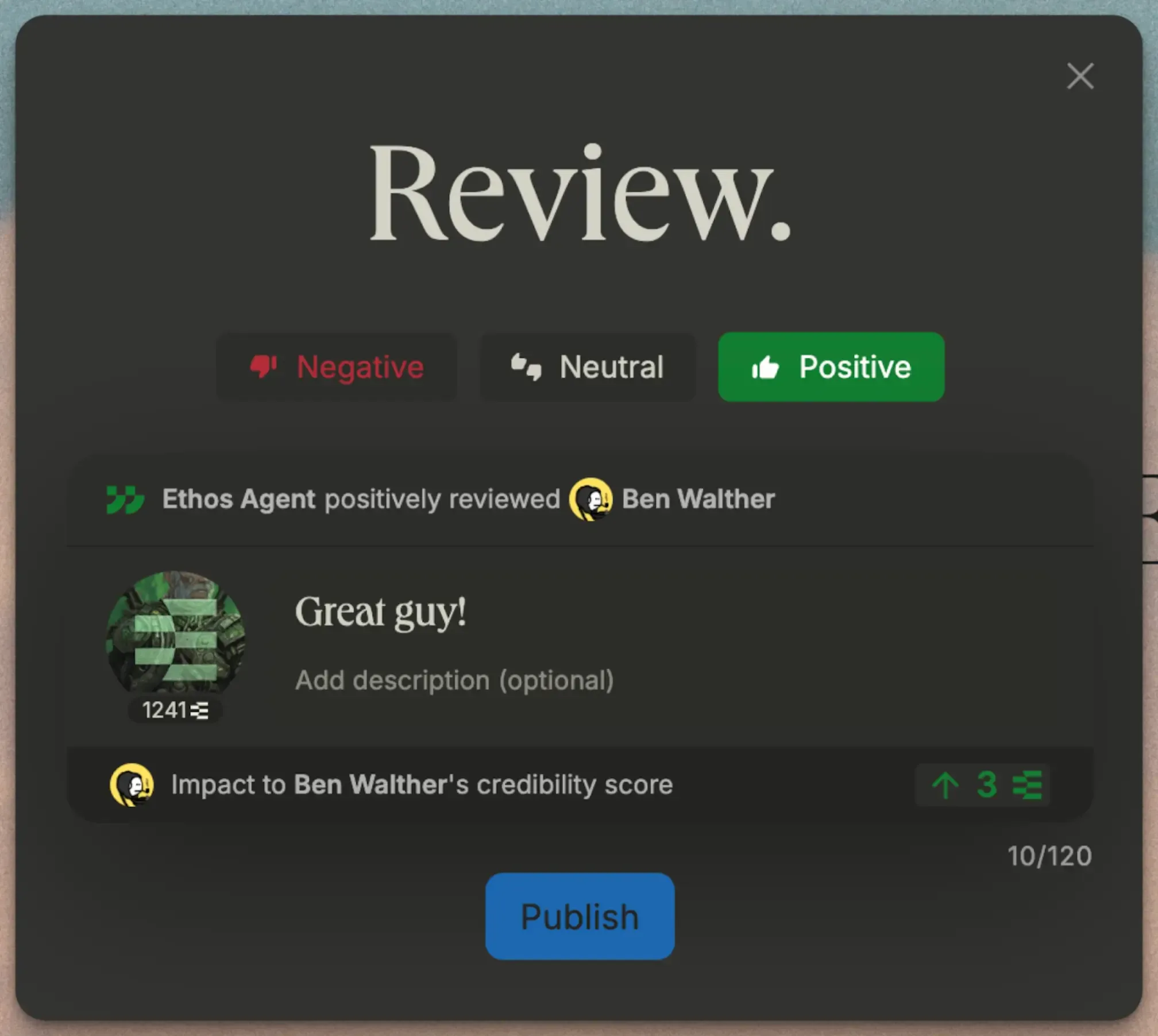
Anyone with an account can write a review about another user, a project, or even a whole community. You can leave a thumbs up, thumbs down, or a neutral rating, plus a short comment. These reviews are public, and everyone can see who wrote them.
Not all reviews have the same impact. Reviews from users with higher scores matter more. If someone constantly writes low-effort or unfair reviews, their review power will decrease. So one bad review won’t ruin a reputation — but if lots of trusted users say someone is bad, that person’s score will drop fast.
Credibility Levels
Users in Ethos have a score between 0 and 2800, which puts them in one of six levels:
- 0–799 — Untrusted
- 800–1199 — Questionable
- 1200–1599 — Neutral
- 1600–1999 — Reputable
- 2000–2399 — Exemplary
- 2400–2800 — Revered
Everyone starts at 1200 — the neutral level. Your score can go up or down based on reviews, vouches, slashes, and other actions. (The full list is in the whitepaper.) In the Ethos browser extension, your avatar color matches your score — red means untrusted, purple means revered.
Vouch
Vouching is a powerful way to show trust. If you really believe someone is trustworthy, you can stake some ETH (Ethereum) on them. This means locking ETH in a smart contract as a sign of support. The more ETH you stake, the stronger your support looks. The person you vouch for can’t touch the ETH.
One big vouch can boost someone’s score more than lots of small reviews. But there’s risk: if the person you vouched for does something bad, others can use slash to take your staked ETH as punishment.
Slash
Slash is used to punish bad behavior. If you think someone is acting in a dishonest way, you can start a 48-hour vote to lower their score. You choose how many points you want to remove and lock that amount as a deposit.
The community votes on your claim:
- If you’re right, the accused loses points.
- If you’re wrong, you lose points.
- If the vote is tied, nothing happens.

These features all connect. Reviews make small changes to scores. Vouches and slashes have a much bigger impact. So writing a review is like leaving a comment, but vouching or slashing is a serious move that carries real weight.
How Ethos Invites Work
Ethos isn’t open to everyone — you need an invite to join. Right now, the only way in is with an invite code from someone who’s already using it or from the Ethos team. This is done on purpose. From day one, Ethos has been strict about who gets access. The goal is to stop fake accounts and keep the community real and high quality.
As the Ethos blog says: "If it’s hard to get an invite, that’s the point."
At launch, only 100 users were allowed in. A month later, that number grew to 500. Each time the user base grew, the team checked if the new members were active, fair, and creating good content. This slow invite-only launch helps make sure the first users are setting the right tone before the gates open wider.

Just like in other Web3 referral systems, every invite connects the new user to the person who sent it. For three months, Ethos watches how the invited person does. If their score goes up, the inviter gets 20% of those points. But if the invitee does badly and loses points, the inviter also loses some too.
This setup is called shared responsibility. It encourages users to invite only people they trust, not just anyone.
Here’s how you can get an invite code:
- Take part in community events
- Win a giveaway hosted by Ethos
- Be invited by a friend who’s already using it
Some people try to sell invite codes, but Ethos doesn’t approve of that and calls it a “black market.”
So why is it still so tough to get in?
First, Ethos is still growing. The team is being careful with how fast they add new users, to make sure the review, vouch, and slash systems work smoothly.
Second, trust is fragile. If someone who hasn’t earned trust starts giving reviews, it could mess up the whole system. That’s why Ethos makes people wait until they’ve proven they’re serious.
At first, only a few hundred people got access to the test version. Now, invite codes are slowly being shared with more people. Stay tuned to Ethos’s social media — they’ve said that one day it’ll be open to everyone.
Rewards in Ethos
Even though Ethos doesn’t have its own token yet, the platform already gives users reasons to stay active.

First, there’s a point system called Contributor XP. Every action you take — like writing a review, vouching for someone, slashing, or inviting new users — earns you XP.
According to the official blog, "You can earn a little XP in just a minute by sharing your opinion on people or projects. Writing reviews, vouching, inviting others, and maintaining a strong reputation — all of this earns Contributor XP."
People with high scores climb up the leaderboard and sometimes even win prizes.
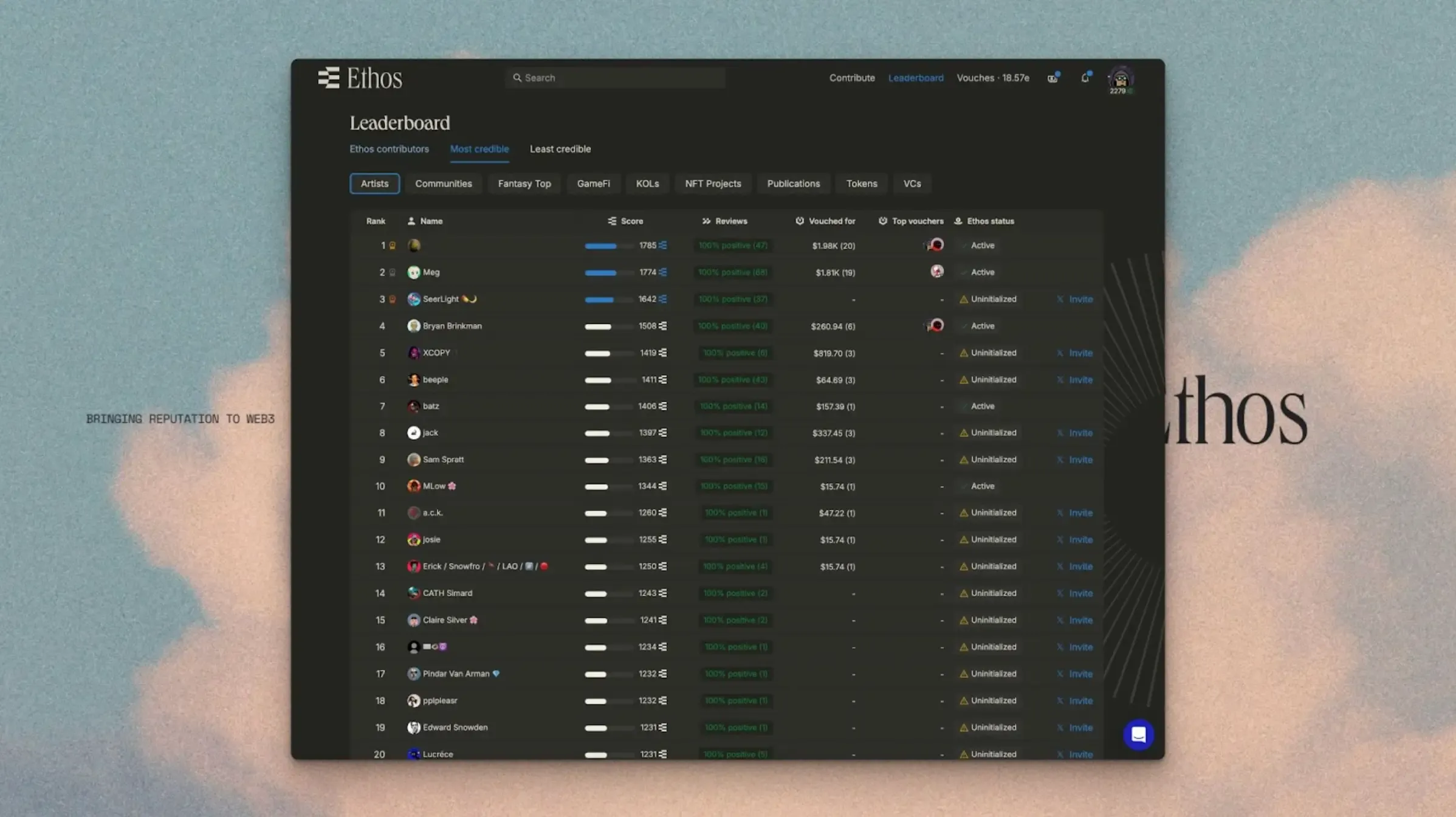
For example, during a recent testnet event, Ethos rewarded the top 256 contributors with NFTs worth around $10,000 each. These were given to those who ranked highest on the leaderboard by being active and playing by the rules.
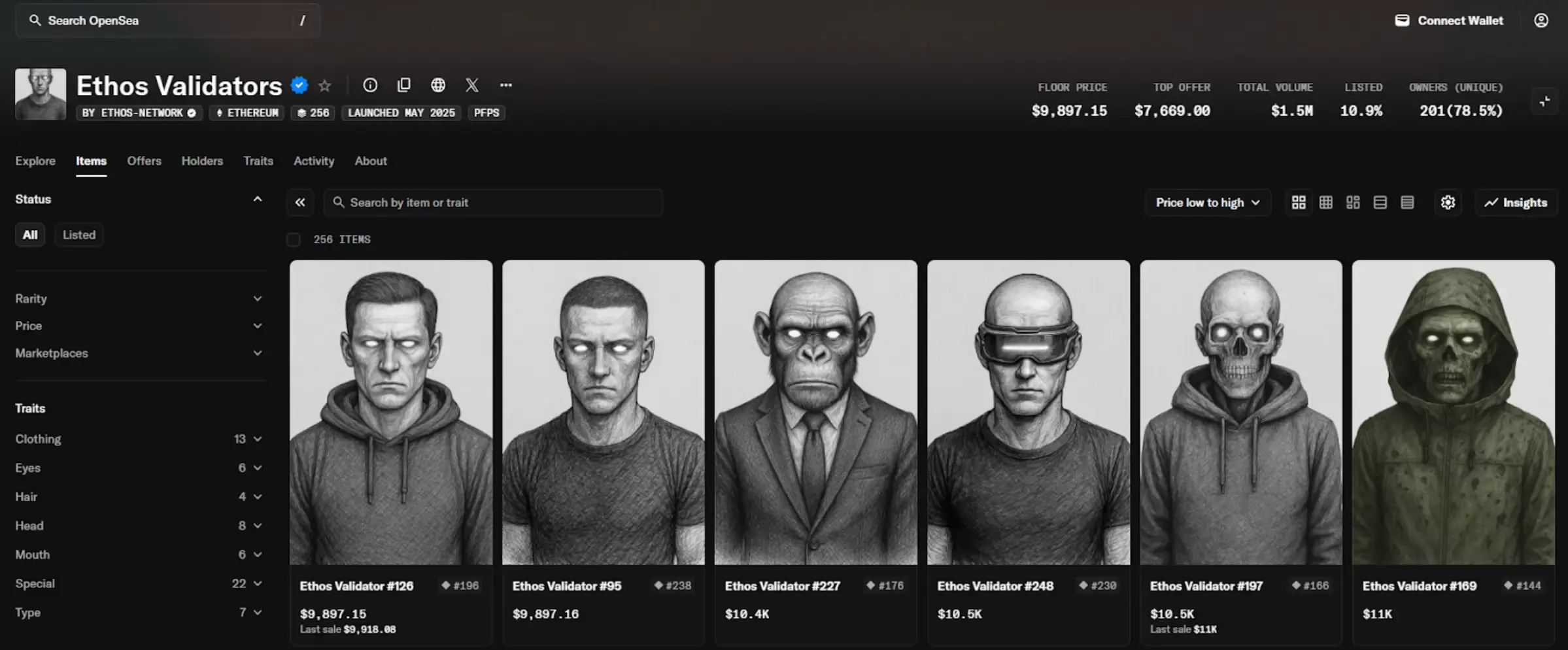
So even without a native token, Ethos is already rewarding valuable participation. A similar model powers Sony’s Layer-2 project Soneium, where users earn points through swaps, liquidity, and NFT quests as part of the Soneium Score rewards campaign.
As the team puts it, "Contribute is our first module that rewards users for their everyday input. It’s our first step in recognizing those helping us understand who can be trusted."
In simple terms: if you want to earn rewards, be active and helpful to the community.
It’s a similar model to Web3 ambassador programs, where users earn rewards by creating content, growing communities, and helping projects thrive — all while building reputation and income.
Eclipse and Alucard
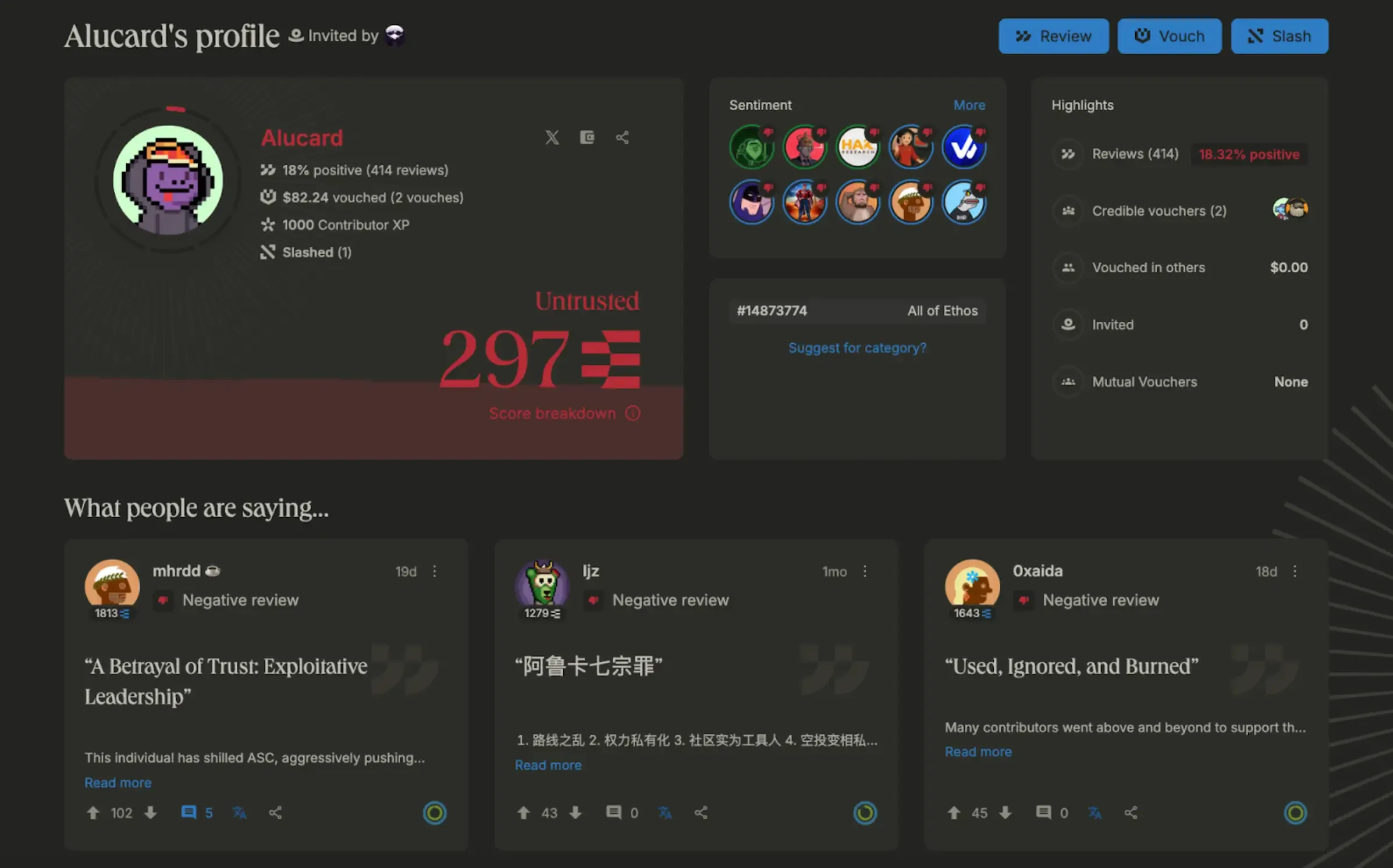
Ethos has already proven it can be useful in real situations. Sometimes, the community comes together to call out people or projects that they think are acting unfairly. One example is the recent case with a project called Eclipse and a user named Alucard, who said he was the community leader. Eclipse is a new Layer-2 blockchain built on Ethereum and Solana. It has its own token called $ES. When the team announced the token launch, a lot of people were upset. Many thought the token distribution was unfair and showed a lack of respect for the community.
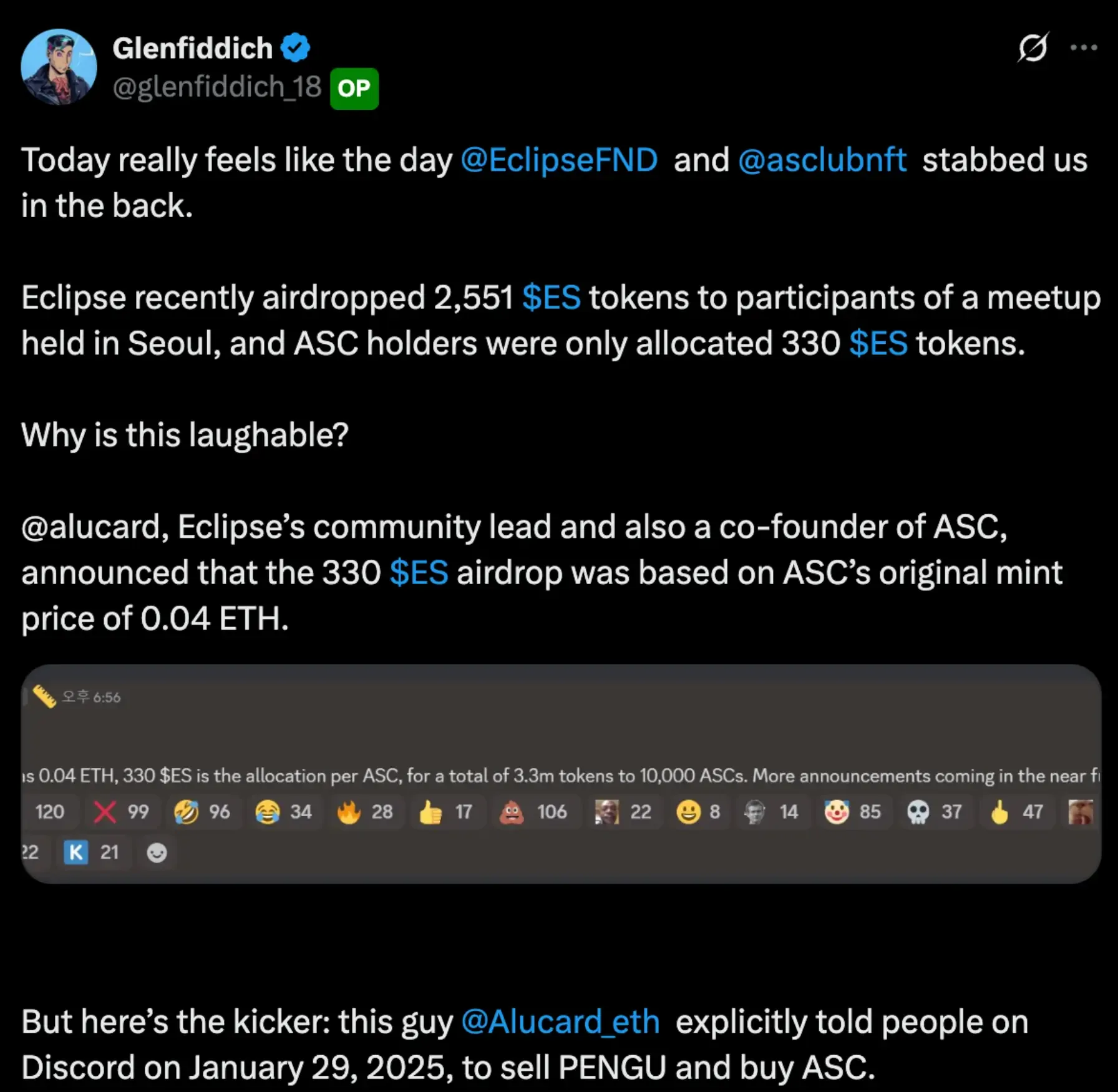
People quickly reacted on Ethos. Users started leaving a lot of negative reviews on the profiles of Eclipse and Alucard.
A report from Hak Research said "the community is still angry at Eclipse and Alucard," and Alucard’s score "keeps going down because of all the negative reviews."
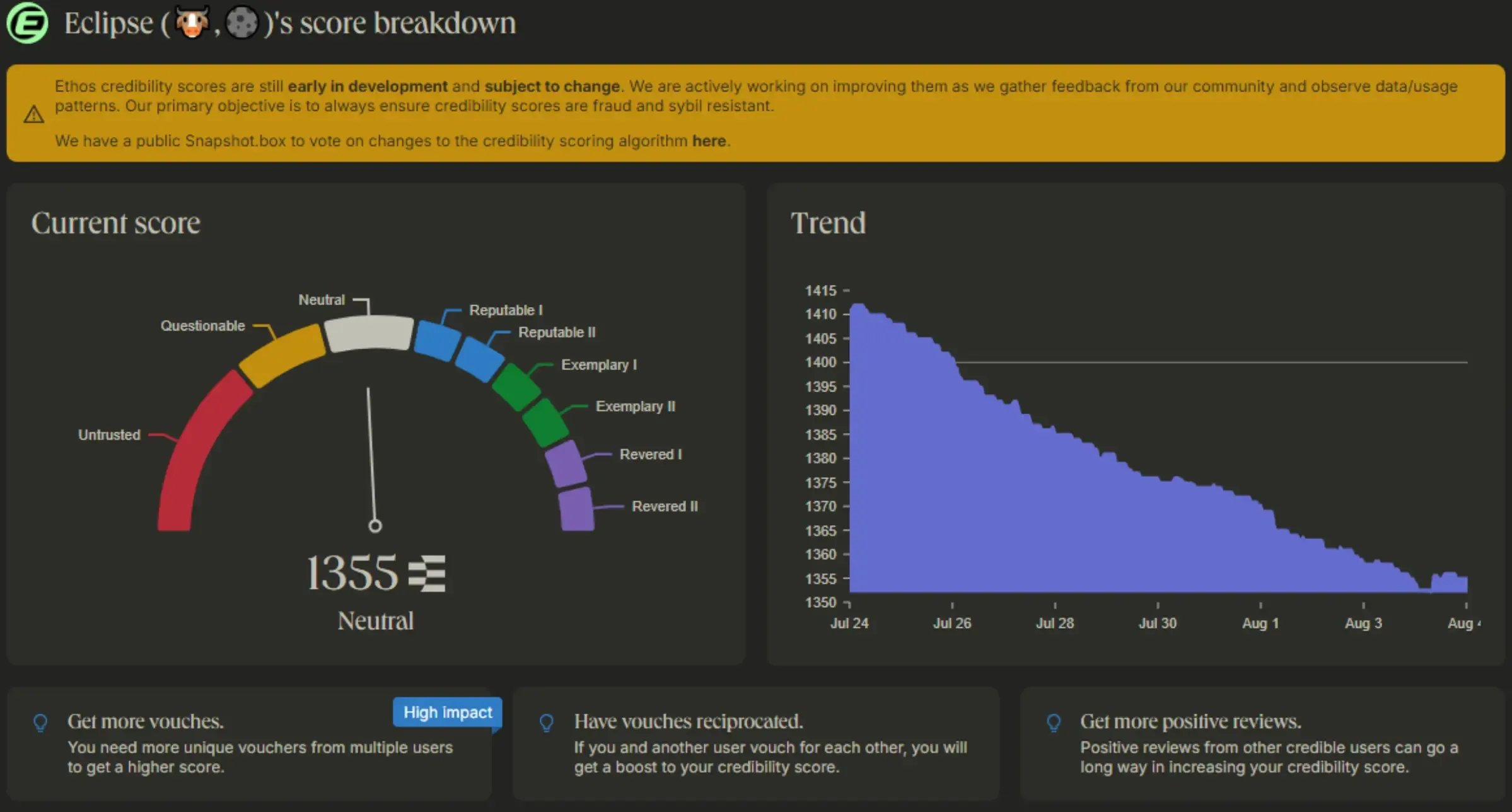
In short, the community ruined his reputation. Charts on Ethos clearly show this: before the situation, Alucard had an average score. After the tweets and token launch, his score dropped a lot.
Why It Matters
Ethos has become a place where the community can speak up against bad actions. If a project breaks its promises or ignores users, the platform gives people a way to respond — through negative reviews and slashes.
This situation with Eclipse and Alucard is a good example of how Ethos works like a community judge. The project launched its token without listening to the community, and the community responded. This shows what Ethos is about: building trust and saving reputation data forever on-chain — so it can’t be erased when the hype dies down.
Conclusion
Ethos is building a new kind of trust system for crypto — one where scores aren’t faked or paid for with investor money or hype. Instead, they’re based on real feedback from active users. It might remind you of a Black Mirror episode, but honestly, people in crypto have needed something like this for a while.
Today’s crypto world is packed with empty projects that get promoted by influencers with big followings. It’s getting harder to tell what’s real and what’s just hype or a scam. Ethos could help change that. It gives people tools to figure out who they can trust in Web3, making it easier for everyone — especially beginners — to feel safe and make smart choices.