
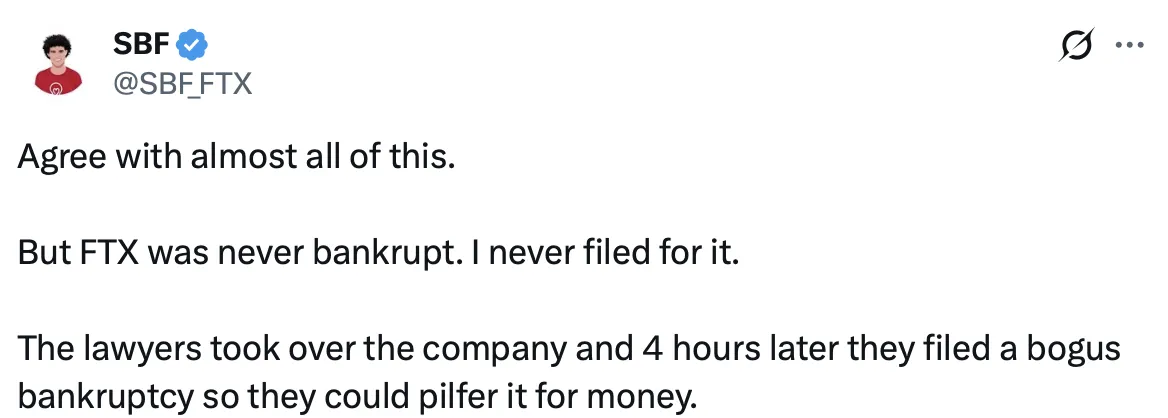
According to him, lawyers took control of the company and filed a fictitious bankruptcy petition in order to receive fees.
As proof, SBF published an excerpt from a court document in which he claims:
- Recommended not to file for bankruptcy for FTX.US until it was determined that the company did not have sufficient assets
- The technical team checked the wallets and confirmed to FTX International's general counsel that FTX.US was not affected by a customer fund shortfall
- Insisted on keeping the FTX.US crypto exchange for sale as a going concern in order to pay preferred shareholders
- Objected to the selection of the law firm Sullivan & Cromwell due to conflicts of interest and inflated fees
According to the document, restructuring chief John Ray told SBF that there is more than $200 million on LedgerX that will be sent to Sullivan & Cromwell to cover bankruptcy legal fees.
Criticism of the trial
Against the backdrop of recent pardons in the crypto industry, questions are being raised about the fairness of SBF's trial. Ryan Salam, former co-founder and CEO of FTX Digital Markets (FTX's Bahamian subsidiary), received a prison sentence for refusing to testify against Bankman-Fried. He was accused of procedural violations unrelated to the loss of customer funds, and his sentence was tripled to set a precedent and put pressure on other witnesses.
Critics note that Judge Kaplan systematically blocked SBF's defense:
- Prohibited the use of the "relied on lawyers" argument (which refutes intent)
- Excluded evidence of FTX's solvency
- Did not allow mention of clause 12 of the user agreement on the risks of margin lending
- Prohibited showing that customers would get their funds back (which refutes damage)
- Conducted an unusual "dry run" of the defense
According to analysts, at the time of the collapse, the actual shortfall in funds was minimal — most of the losses were due to the market crash and the liquidation of Alameda's positions in the margin lending system. FTX remained a highly profitable business, and without bankruptcy proceedings, customers could have gotten their funds back faster.
All transactions are tracked on the blockchain, but no evidence of embezzlement by SBF himself has been found. Moreover, he tried to keep the exchange afloat until the very end, which contradicts the motive for fraud.