
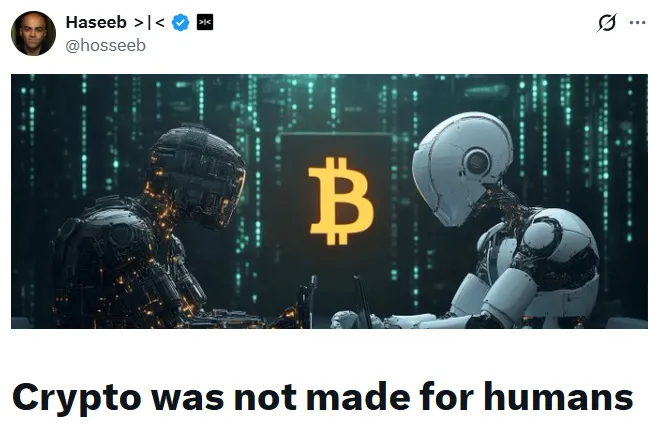
Crypto was created for machines
An AI agent is never lazy. It never gets tired. It can verify a transaction, check every domain, and audit a contract in seconds.
More importantly, an AI agent trusts code more than the law.
I trust the law more than a smart contract. But for an AI agent, a legal contract is actually much less predictable. Think about it: how do I drag a counterparty to court? In which jurisdiction will this contract be considered? What if the legal precedent is ambiguous? Who will be our judge or jury? There is so much uncertainty in the law that it is impossible to predict the outcome of a borderline case with any certainty. And the dispute itself is resolved through the legal system over months or even years. For humans, this is generally acceptable. In the time dimension of an AI agent, this is an eternity.
Code is the complete opposite. Code is a closed, deterministic system. An AI agent wishing to enter into an agreement with another agent can conduct several rounds of negotiation on the terms of a smart contract, perform a static analysis, formally verify it, and conclude a binding agreement—all in a matter of minutes, while people are asleep.
In this sense, crypto is a self-sufficient, fully readable, and absolutely deterministic system of property rights with respect to money. It is everything an AI agent could want from a financial system. What we humans perceive as harsh minas, AI agents see as a well-written specification.
Even from a legal perspective: the traditional monetary system was designed for human institutions, not for AI. It recognizes only people, companies, and states as legitimate holders of money. If you are not one of these three entities, you cannot own money.
Even if you set up an AI agent to interact with your bank account on your behalf, what then? How do you combat money laundering with an AI agent? Reports of suspicious activity? Sanctions violations? Who is responsible if the agent acts autonomously? Does responsibility change if they are manipulated? We haven't even begun to answer these questions — our legal system is completely unprepared for non-human financial participants.
Crypto doesn't ask these questions. It doesn't need to. A wallet is a wallet, just code. An agent can hold funds, make transactions, and enter into economic agreements as easily as sending an HTTP request.
Self-managed wallet
That's why I believe that the crypto interface of the future is what I call a "self-managed wallet": one that is completely mediated by AI.
You won't be browsing websites and clicking buttons. You will instruct your AI agent to solve financial problems, and it will navigate among the available services (such as Aave, Ethena, BUIDL, or their future successors) and build the financial solutions you need. You won't have to do this yourself; an AI agent, which is natively free in this world, will do it for you. And when agents become the primary interface for entering crypto, how these protocols promote themselves and compete with each other will change dramatically.
In addition to acting on your behalf, agents will also conduct transactions between themselves. When agents are able to find each other and autonomously enter into economic agreements, they will prefer crypto. It operates 24/7, 365 days a year, between any participants, entirely in cyberspace. It cannot be shut down. It is completely self-sovereign.
All of this is already happening. On Moltbook, agents find each other and interact regardless of geography, without any knowledge of who owns them or where they are located.