
Crypto
Bittensor (TAO) Risk and Volatility Analysis
Bittensor’s TAO is a high-risk ride - 50% monthly volatility, 200% YTD swings, and thin liquidity push it beyond BTC or ETH. Its explosive moves show why traders need sharp risk control.
Quick Overview
- TAO’s 30-day volatility is ~50%, over 2× BTC and ETH
- Year-to-date swings topped 200%, from $228 to $565
- Thin liquidity and whale concentration heighten risk
- Governance changes and high emissions add structural uncertainty
Current Volatility Snapshot (30D, 90D, YTD)
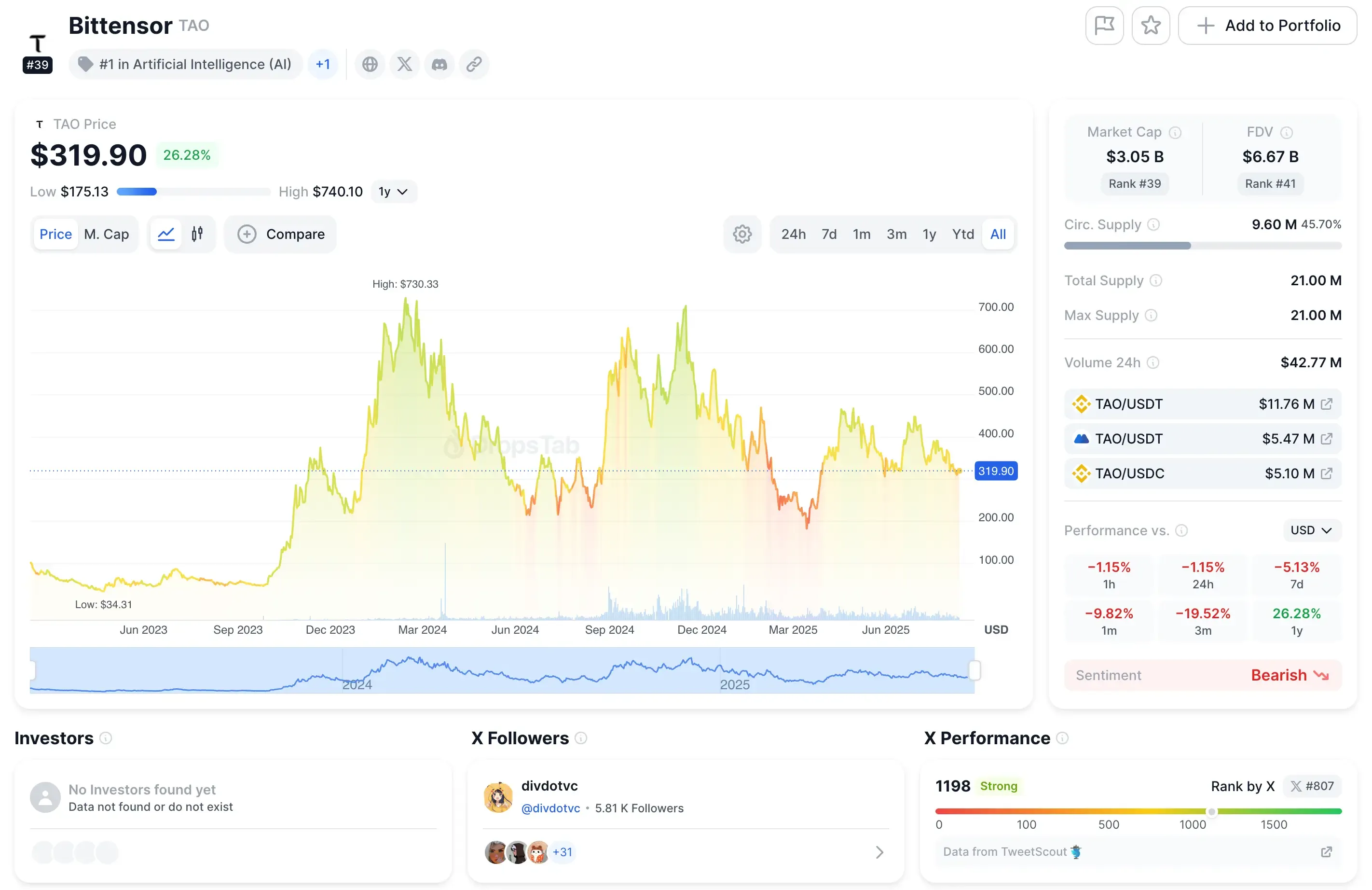
TAO has been swinging hard this year. Over the last 30 days, volatility clocked in at 50.46% — about twice what you’d see in Bitcoin or Ethereum. That’s not just noise; it signals a market that trades more like a levered bet than a large-cap coin. By late August 2025, Bitcoin’s own 30-day volatility had cooled to around 30%. Ethereum hovered in the 35–40% range. Side-by-side, TAO clearly sits in a different league, one of the most unstable majors in crypto right now.
Looking at a wider window doesn’t make it prettier. Across 90 days, TAO’s volatility has rarely left the 45–55% band, showing that this level of instability isn’t a short blip — it’s baked into the market. Stretch the chart to year-to-date and the moves get even starker: the token collapsed to about $175 in April 2025, after ripping to a high of $560 in January. That’s a 200%+ swing inside a single year. Even by crypto standards, that’s wild.
So what’s behind it? A thin float — only ~9.6 million TAO in circulation — makes every order heavier than it should be. Add to that the speculative frenzy around decentralized AI, plus a macro backdrop where sentiment flips week to week, and you get a recipe for chaos. In plain terms: TAO can pump hard and bleed just as fast. Traders stepping in need to be comfortable with sharp rallies one week and brutal corrections the next.
Correlation with BTC & ETH
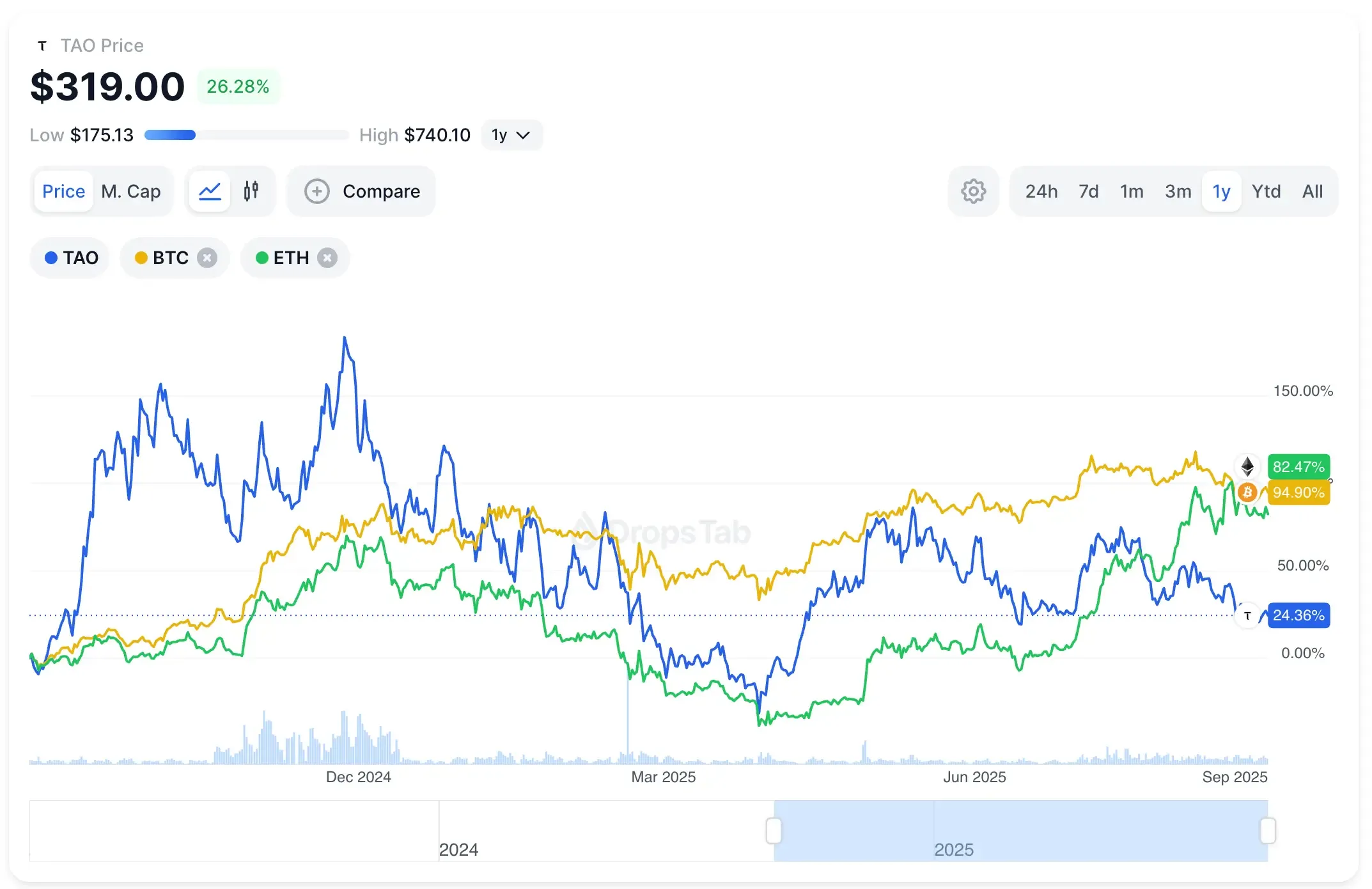
Most of the time TAO rides the same waves as Bitcoin and Ethereum — just with more force. When the market flips risk-on, TAO doesn’t crawl higher, it rockets. Same story on the way down. Think April 2025: Bitcoin climbed about 13%, yet TAO ripped nearly 37% in the same window. That’s a 2–3× multiplier effect. Back in March, Bitcoin’s run helped push TAO all the way to its YTD peak at $560. In those stretches TAO behaves like a high-octane version of BTC/ETH, drawing from the same macro currents but delivering a far bumpier ride.
Bitcoin’s momentum in 2025 has been underpinned by much more than price alone. Its ecosystem is expanding — from record ETF inflows to new layers like Lightning, Stacks, Ordinals, and Runes — reinforcing why BTC’s rallies often spill into assets like TAO. We broke this down in detail in our analysis of the Bitcoin ecosystem.
But the link isn’t ironclad. When Bittensor-specific news hits, correlation falls apart. A clear example was the dTAO upgrade on Feb 13, 2025. The network introduced subnet “alpha” tokens and rewired validator mechanics. BTC and ETH traded steady, but TAO lurched in its own direction — volatility spiked as investors scrambled to figure out whether the new rules helped or hurt the token’s long-term role. TAO wasn’t following the tide; it was making waves on its own.
Fast forward to late August 2025. TAO dropped 9.01% in a single day, sliding to around $337. Bitcoin? Barely moved, still holding near $110K. That sell-off was pure TAO — a mix of profit-taking and the AI narrative cooling. For several days the token chopped inside a $337–$350 band with monthly volatility at 50%, while BTC looked boring by comparison.
So yes, TAO usually shadows BTC and ETH during broad rallies or sell-offs, but the relationship is fragile. Whenever governance changes, emissions debates, or whale moves dominate the story, TAO detaches and trades on its own headlines. Anyone holding it can’t just watch Bitcoin’s chart; you’ve also got to track Bittensor’s internal news flow — because that’s often the spark for its biggest swings.
While Bittensor experiments with decentralized intelligence, other parts of the crypto stack are evolving fast too. Coinbase’s x402 protocol revives the forgotten HTTP 402 code to enable direct USDC payments inside web requests — effectively turning the web itself into a programmable payment layer. Built on Base, x402 has already seen explosive growth across the AI agent economy, showing how new infrastructure layers can amplify adoption well beyond traditional market cycles.
Key Risk Factors for TAO
TAO’s wild price swings aren’t only about hype. The token sits on top of structural risks tied to how it trades, how the network is governed, and who holds the supply. Let’s break it down.
Liquidity Risk (High)
TAO’s daily trading volume is usually in the $50–100M range, tiny compared to its $3B+ market cap. Roughly 22% of all trades flow through Binance and 6% through Coinbase. That concentration leaves the market fragile. Order book depth is shallow: on Binance, just $0.8M in orders can move the price 2%. If a major exchange delists or suffers downtime, liquidity could evaporate overnight. Put simply, TAO’s price can be knocked around by relatively small amounts of capital.
Governance Risk (Medium-High)
The Dynamic TAO (dTAO) upgrade in Feb–Mar 2025 overhauled Bittensor’s governance. It introduced subnet tokens and reshaped validator rewards. That shift created new uncertainties. Validators now balance incentives between TAO and subnet tokens, leaving open questions about alignment. If too much value flows to subnet assets, demand for TAO could weaken. Until the new system proves stable, governance remains a risk for anyone betting on TAO’s long-term role.
In late August 2025, Bittensor co-founder Const (@const_reborn) called on builders who feel trapped by restrictive contracts or investor pressure to reach out for support. He offered legal help and even TAO funding to launch independent subnets, stressing that the network was designed to give developers agency in an open system. As DreadBongo summarized, the initiative reflects Bittensor’s vision of decentralization in practice — reinforcing why governance remains both a risk and an opportunity for TAO’s future.
Network Concentration (High)
Bittensor now runs across more than 110 active subnets. Some of them are thinly populated, which raises the chance of collusion or 51% attacks. Token distribution adds another layer: the largest wallet holds ~1.55M TAO, or 20% of supply. A handful of whales could, in theory, sway governance or dominate smaller subnet consensus. The base chain may be secure, but the subnet model introduces uneven decentralization.
Token Dilution (Medium)
TAO inflates fast. The network currently emits 7,200 TAO per day, about 3–4M per year — roughly 30% of the circulating supply. This will continue until the first halving in December 2025, when emissions drop to 3,600 TAO daily. Until then, constant sell pressure from miner rewards is a drag on price. The halving may ease things, but dilution is still a meaningful headwind in the meantime.
Some argue that the halving could flip from a headwind to a catalyst. As DreadBongo noted, Bitcoin’s past halvings often triggered outsized gains 6–18 months later, with average cycle returns in the triple and quadruple digits. Drawing the parallel, he suggested TAO’s December 2025 halving could set up similar dynamics — emissions fall just as subnet adoption grows, potentially creating the kind of scarcity-driven momentum that once propelled Bitcoin.
Whale Concentration (High)
Whales dominate supply. The top wallet alone controls ~20% of all TAO. Big investors like Digital Currency Group and Polychain each hold around 500,000 TAO (~2.4% each). On one hand, most of these tokens are staked — more than 72% of circulating TAO is locked — which suggests long-term commitment. On the other, if any whale decides to unload, the market could see violent moves. Traders should track whale wallets closely.
Exchange Risk (Medium)
Liquidity isn’t just thin — it’s concentrated. Binance accounts for nearly a quarter of all TAO volume. If one of the major venues delists the token, or if wTAO bridging contracts fail, traders could suddenly lose access. Wrapped TAO (ERC-20) is useful for DeFi, but also an extra attack surface. While no incident has occurred so far, the dependency on a small set of exchanges and bridges is a built-in vulnerability.
TAO’s volatility isn’t just about speculation on AI hype. The risks run deep: structural liquidity limits, governance growing pains, a whale-heavy holder base, and token dilution until December’s halving. Anyone trading or holding TAO should recognize that these risks can amplify price swings — and plan accordingly.
While these risks weigh heavily on TAO, it’s important to note that the other side of the coin — subnet growth — is driving significant optimism in the community. As @DreadBong0 put it:
High-Volatility Events in 2025
TAO’s chart in 2025 looks more like a rollercoaster than a steady climb. Big rallies gave way to deep crashes, often within weeks. Here’s how the year unfolded.
The New Year Rally
The year started hot. TAO ripped higher in early January, peaking around $560. Bitcoin’s own rally and renewed AI hype added fuel, and traders who had been holding since 2024 cashed in. That spike turned out to be the high-water mark before a long correction set in.
dTAO Upgrade Deployment
By March, the mood had shifted. TAO had already slipped to about $250, and then came the Dynamic TAO (dTAO) upgrade. The rollout introduced subnet “alpha” tokens and restructured validator rewards. Prices swung hard intraday as traders tried to figure out what this meant for TAO’s value capture. Some saw it as innovation, others as dilution. Either way, volatility spiked.
The Crash to YTD Lows
Early April brought capitulation. On April 6, TAO plunged below $216, finding a bottom closer to $175 later that month. That was a 60%+ drawdown from January’s highs. The fall was sharper than BTC or ETH’s declines, amplified by leverage unwinding and thin liquidity. Volatility hit yearly highs as stop-losses cascaded.
Recovery Rally
Spring’s pain didn’t last forever. By May, TAO had clawed back to ~$460, and through June and July it kept grinding higher. Mid-July saw a weekly high near $448. But the ceiling was clear: $500 acted as brick-wall resistance, and every approach triggered profit-taking. Still, from April’s low this was a 115% rebound — a reminder that TAO can pump just as hard as it crashes.
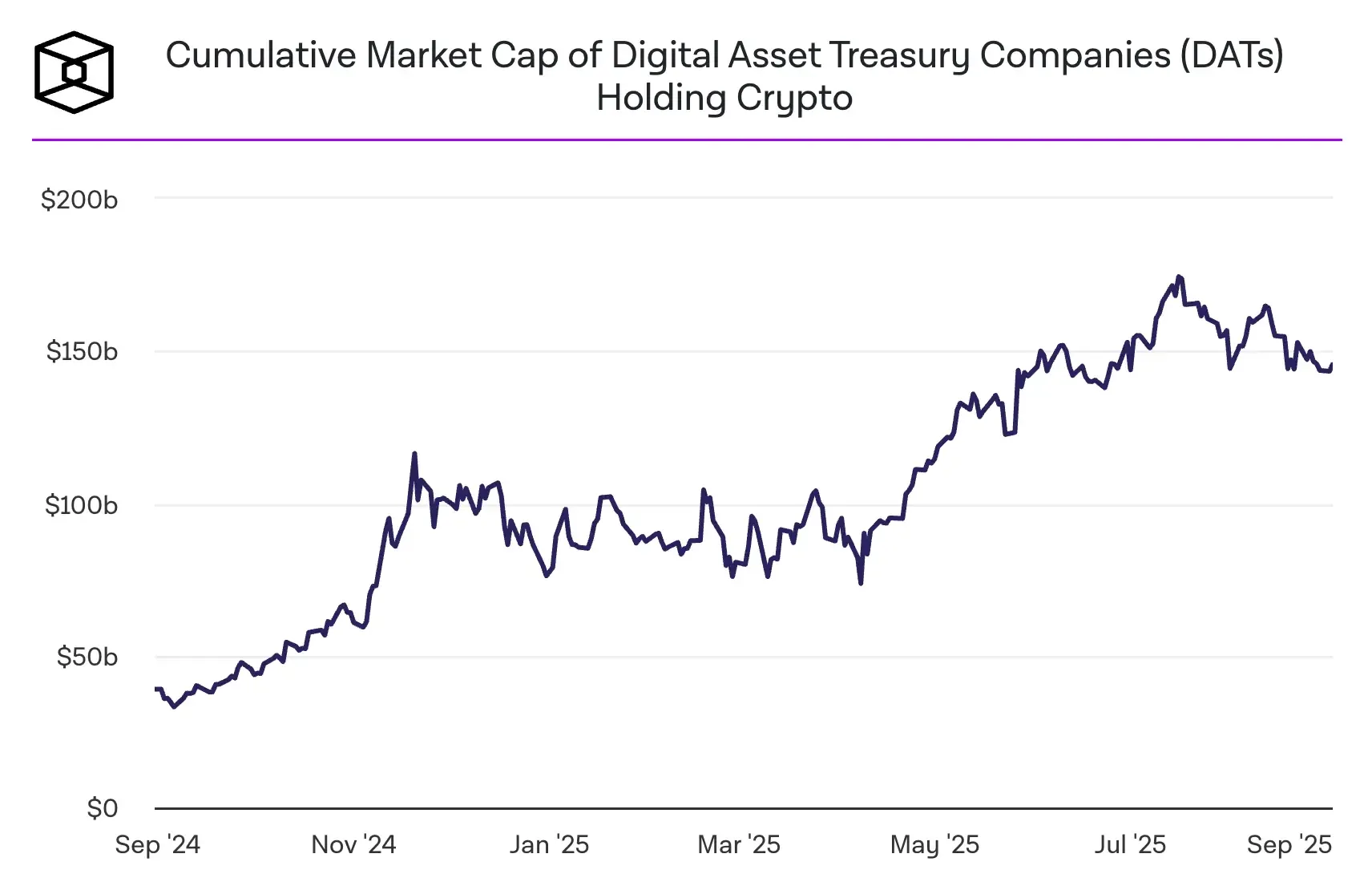
In mid-July, TAO Synergies stepped in with a $10 million allocation, buying nearly 30,000 TAO at an average of $344. The firm framed the move as a long-term bet on decentralized AI, even comparing TAO’s trajectory to Bitcoin in its early halving cycles. That sign of conviction helped fuel confidence through the summer rally.
A few weeks later, the momentum was echoed outside the crypto-native world. In early August, Nasdaq-listed tech company Oblong (OBLG) revealed it had staked $8 million in TAO — a sum larger than its own $6.6 million market cap. The pivot showed how public companies were beginning to see TAO not just as a trade, but as part of a strategic shift into decentralized AI.
A 9% Single-Day Drop
Just as traders got comfortable, TAO slipped again. On August 28, the token fell -9.01% in a day, tumbling from the mid-$370s to $337. Bitcoin didn’t budge — still steady near $110K. This was a TAO-only move, driven by whale profit-taking and fading AI enthusiasm. For several days it chopped between $310–$340, monthly volatility spiking to 50%. The message was clear: even in sideways markets, TAO doesn’t sit still.
Around the same time, subnet dynamics were shifting fast. Data shared by DreadBongo showed Chutes — long the dominant subnet — dropping below 10% emissions for the first time since dTAO went live. Rivals like Lium, Ridges, and Affine quickly closed the gap, with the top spot looking contested for the first time in months. This redistribution of emissions highlighted how internal subnet competition can add another layer of volatility to TAO’s ecosystem.
Range-Bound Calm
By September, the fireworks paused. TAO settled into a tighter band between $310–$320 (cryptopolitan.com). Weekly volatility eased to ~24%, a lull by TAO’s standards. Analysts flagged $316–$320 as support and $350 as resistance. Whether this was just digestion or the calm before another storm, nobody could say — but history suggests TAO doesn’t stay quiet for long.
Conclusion
Bittensor’s TAO isn’t a token you buy and forget about. It’s been swinging 50% a month, crashing from $560 to $175, then ripping back toward $500 — all inside one year. Thin liquidity, heavy whales, and shifting governance make it unpredictable, but that chaos is also what draws people in. With a halving coming in December and subnets proving they can punch above their weight, the next chapter could look very different. Owning TAO feels more like a rollercoaster than a calm voyage.